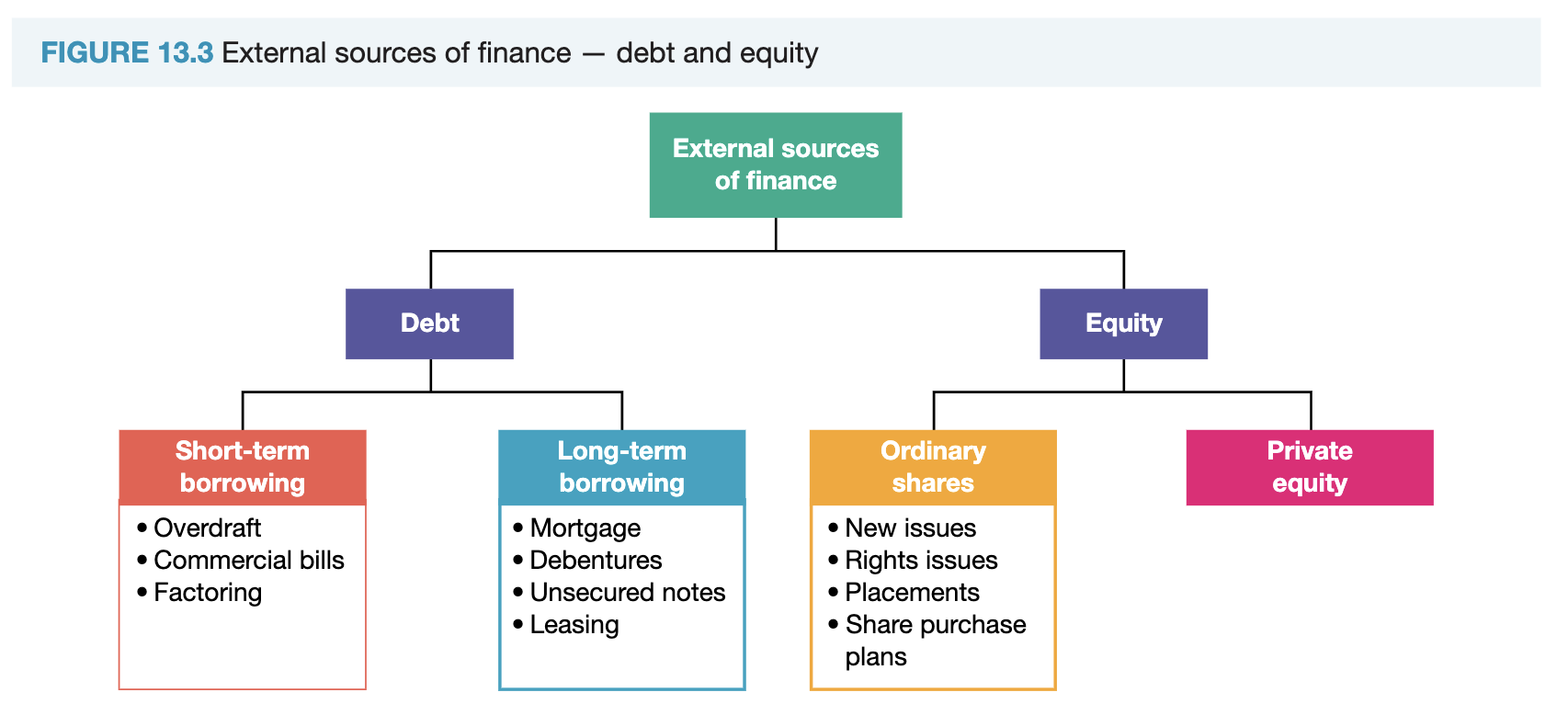
- External finance refers to the funds provided by sources outside the business, including banks, other financial institutions, government, suppliers or financial intermediaries.
Debt:
Short-term borrowing:
- included on balance sheets as ==current liabilities==
- Less than 12 months
- The sources of short-term debt are:
? - Overdraft
- Commercial bills
- Factoring
Overdraft
- One of the most common types of Short-term borrowing
- An overdraft is when :: A bank allows a business or individual to overdraw their account up to an agreed limit and for a specified time
- to help overcome a temporary cash shortfall
- Costs are minimal; lower interest rates than other forms of borrowing
- interest is paid on the daily outstanding balance of the account.
Commercial bills
- Commercial bills are :: primarily short-term loans issued by financial institutions, for larger amounts (usually over $100 000) for a period of generally between 30 to 180 days.
Factoring
-
Factoring is :: the selling of accounts receivable for a discounted price to a finance or factoring company
-
It enables a business to raise funds immediately by selling accounts receivable at a discount to a firm that specialises in collecting accounts receivable
-
A factoring company may offer its services with or without recourse, meaning:
?- ‘Without recourse’ means that the business transfers responsibility for non-collection to the factoring company.
- ‘With recourse’ means that bad debts will still be the responsibility of the business.
Long-term borrowing:
- included on balance sheets as ==non-current liabilities==
- More than 12 months
- The sources of long-term debt are:
? - Mortgage
- Debentures
- Unsecured notes
- Leasing
Mortgage
- A mortgage is :: a loan secured by the property of the borrower (business), (property as collateral)
Debentures
- a debenture is :: a promise issued by a company to repay a loan for a fixed rate of interest and for a fixed period of time
- investors can buy debentures from a company with promised returns at an interest to their original investment (less secure than a bank) (greater interest)
Unsecured notes
- An unsecured note is :: a loan from investors for a set period of time. that are not secured against the businesses’s assets (high risk to investors)
Leasing
- leasing is :: the payment of money for the use of equipment that is owned by another party
- Viable for businesses with a liquidity problem
- businesses can sell their assets, and lease them back (re leasing)
- Lease payments are tax deductible
Equity
- equity as an external source of funds‚ refers to :: the finance raised by a company through inviting new owners
- used as an alternative to debt funding
- Equity as a source of external finance includes:
? - ordinary shares (new issue, rights issue, placements, share purchase plan)
- private equity
Ordinary shares
?
-
Ordinary shares are the most commonly traded shares in Australia.
-
The purchase of ordinary shares by individuals means they have become part owners of a publicly listed company.
- they get voting rights according to the number of shares
- as well as payments called dividends:
-
a dividend is :: a distribution of a company’s profits (either yearly or half-yearly) to shareholders, calculated as a number of cents per share
-
different types of ordinary shares commonly traded in Australia:
- New issue
- a security that has been issued and sold for the first time on a public market
- e.g. Initial public offerings (IPOs)
- must prepare a prospectus and lodge it with ASIC
- Rights issue
- an invitation to existing shareholders to purchase additional new shares in the same company at a certain date and discounted price
- This type of issue gives existing shareholders securities called rights.
- used to raise additional funds
- Placements
- non-existing shareholders
- involves creating new shares in return for capital and issuing them to selected investors at a discount to their current trading price
- to special institutions or investors who are able to invest a large sum of money.
- intended to persuade specific investors to invest in the company.
- Share purchase plans
- an offer to existing shareholders in a listed company to purchase newly issued shares in that company without brokerage fees.
- usually offered at a discount to the current market price.
- allows companies to issue new shares to current shareholders without issuing a prospectus
- can only issue a ==maximum of $30 000== in new shares to each shareholder.
- New issue
Private equity
- Private equity is :: the money invested in a (private) company not listed on the Australian Securities Exchange (ASX).
- to raise capital to finance future expansion/investment of the business.