The employment contract
- The Employment contract is :: a legally binding, formal agreement between an employer and employee
Common law
- Common law is :: laws developed by courts and tribunals.
- Judges make decisions based on the facts of a case, guided by a precedent.
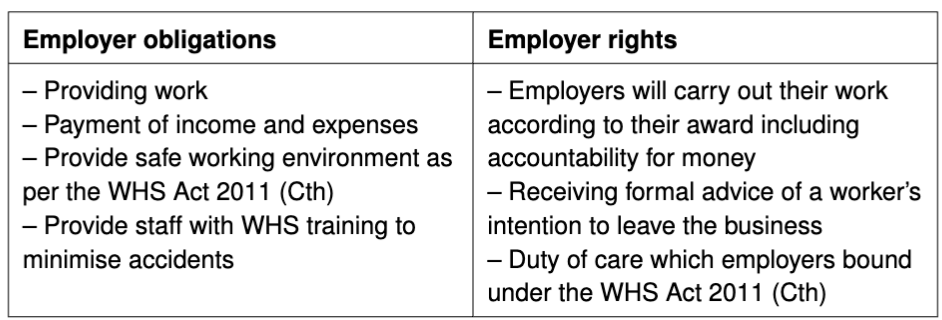
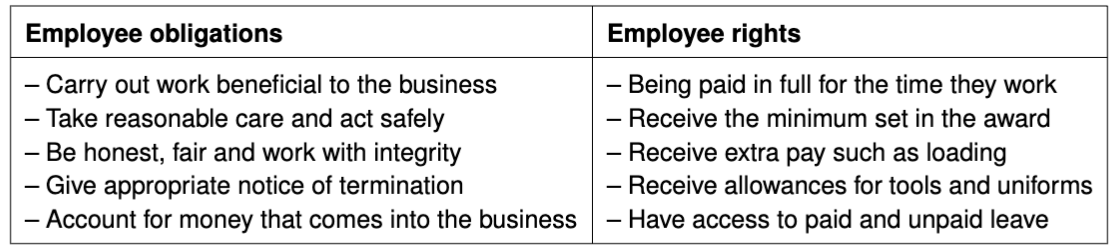
- Under common law, both parties have basic obligations in any employment relationship.
Minimum employment standards
- must be provided by employers
- and state the minimum conditions for employees
- provides a greater safety net for employees
- especially the venerable (or low paid) ones
- provides basis from which modern awards and enterprise agreements are constructed
Minimum wage rates
- minimum wages are determined by awards, enterprise agreements, or national minimum wage.
- every year they are reviewed by the Fair Work Commission’s Minimum Wage Panel.
Awards
-
An award is a :: determination that explains the legally enforceable minimum terms and conditions that apply to a business or industry.
- legally enforceable, formal agreements made collectively between employers and employees
- (and their reps at the industry level)
- legally enforceable, formal agreements made collectively between employers and employees
-
Modern awards are a key feature of the current industrial relations system
-
Awards have recently undergone award simplification
- to reduce confusion surrounding proper Minimum employment standards
- Award conditions still apply on top of the National employment standards and act as a basis for negotiation in Enterprise agreements
-
Contents of modern awards include:
? -
Base pay rates
-
Overtime and penalty rates
-
Allowances
-
Leave and leave loading
-
Hours of work
-
Superannuation entitlements
-
Individual Flexibility Agreements (IFA) allow :: an employer and employee to come to an agreement that varies the modern award or enterprise agreement to address their individual circumstances.
Enterprise agreements
-
Enterprise agreements are
? -
collective agreements made at a workplace level between an employer and a group of employees about terms and conditions of employment.
- Key features:
- over pay rates, penalty rates, overtime, allowances, hours, and leave.
- Key features:
-
must be approved by the Fair Work Commission
- must be a genuine agreement in a timely and fair manner
- passes a ‘better off overall test’ (BOOT)
- does not include unlawful terms
-
Under Fair Work Act 2009, the three types of enterprise agreements are:
? -
Single enterprise: between a single employer and group of employees
-
Multi enterprise: between two or more employers and groups of their employees
-
Greenfields agreements: a (genuinely) new single-enterprise and multi-enterprise agreement, made before having any employees covered by it
-
a ‘better off overall test’ (BOOT) requires that :: each of the employees to be covered by the agreement is better off overall than under the relevant modern award.
Other employment contracts
-
Individual contracts are:
? -
when an employer and individual employee negotiate a contract covering pay and conditions
-
more common in the private sector, professionals, and management
- ==who currently earn > $153,600/year==
- (figure changes annually)
- ==who currently earn > $153,600/year==
-
Independent contractors (a.k.a. consultants/freelancers)
? -
undertake work for others but do not have the same legal status as an employee
-
Fair Work Commission provides clear criteria to determine whether someone is a contractor or an employee
-
Casual employment
? -
employment that is short-term, irregular, and uncertain.
-
casual employees not entitled to paid holiday or sick leave
-
increased from ==16% (1990) to 30% (2013)==
-
employers often prefer casual as it reduces on-costs
-
on-costs are :: additional costs involved in hiring an employee, above the cost of their wages. (adds to approx. 25% of the raw wage cost)
-
Part-time employment
? -
continuing employment and work <38 hours/week
- they receive entitlements on a pro-rata basis
- (in proportion to the % of time worked relative to a full-time employee)
- they receive entitlements on a pro-rata basis
-
25%~ of part-time workers are under-employed