-
TODO watch + notes on all transformation videos 🔼 📅 2023-10-31
-
there are 3 types of transformations:
- Translations
- dilations
- reflections (often combined w/ dilations)
-
Each of them can occur vertically or horizontally
Vertical:
Vertical Translations:
- translate means to shift
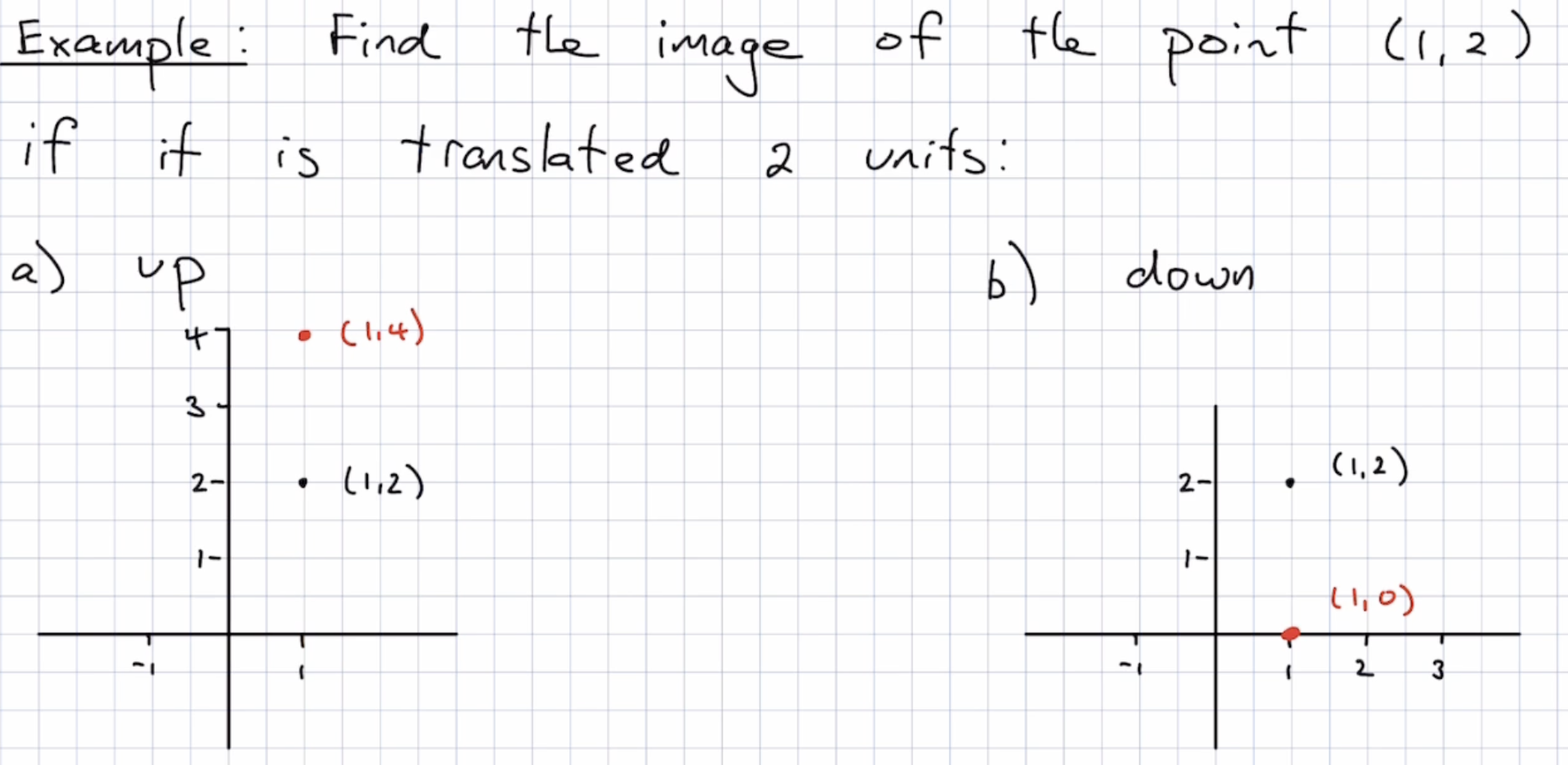
- a vertical translation of a point means only the y value changes
- e.g. image:
- translation of graphs:
- each point maps to
- e.g. to translate the graph up by 2 would be
y=f(x)+c
#### Vertical Dilations: - a stretching or compressing in the y direction - by multiplying the y value by a constant - e.g. image: - ![[Pasted image 20231026141447.png|600]] - Dilation of graphs: - Each point $(x,f(x))$ maps to $(x,k \times f(x))$. - e.g. to stretch the graph $y=f(x)$ vertically by a factor of 2 would be $y=2f(x)$. - $$ y=k(f(x))Horizontal:
Horizontal Translations:
- horizontal translation shifts the graph left or right.
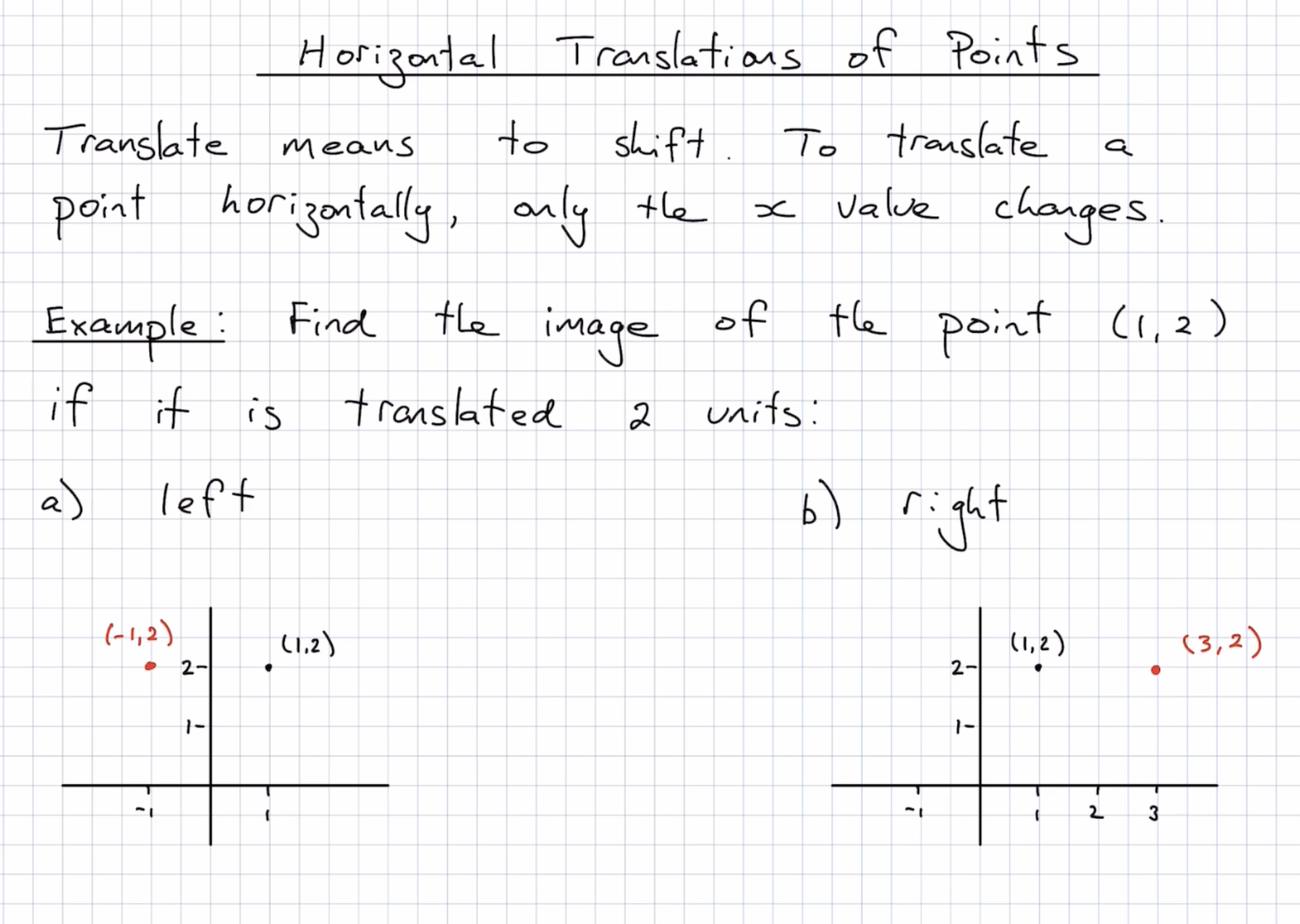
- horizontal translation means only the x value changes
- e.g. image:
- translation of graphs:
- e.g to horizontally translate a graph 3 left
- a point maps to
- the function which has the input & the output :
- ^ which is the graph of translated 3 to the left
y=f(x+b)
- ^ is $y=f(x)$ translated horizontally by $|b|$ - left if $b>0$ - right if $b<0$ #### Horizontal Dilations: - horizontal Dilation stretches or compresses in the x direction - by multiplying the x value by a constant (the y val doesn't change) - e.g. image: - ![[Pasted image 20231026143551.png|600]] - dilation of graphs: - e.g. to horizontally dilate a graph ($y=f(x)$) by a factor of 3 - a point $(x,f(x))$ maps to $(3x,f(x))$ - the function which has the input $3x$ & the output $f(x)$: - $y=f\left( \frac{1}{3}x \right)$ - ^ which is the graph of $y=f(x)$ dilated horizontally by a factor of 3 - $$ y=f(ax)- ^ is $y=f(x)$ dilated horizontally by a factor of $\frac{1}{a}$
-