Time lags
-
Policy lag refers to (and consists of):
? -
the time between a change in the stance of a policy and its effects on real eco activity and behaviour
- (Policy lag = Implementation lag + Impact lag)
- Implementation lag : time taken for gov to make, change, or introduce new eco policies
- Impact lag : time taken for a new policy (or change) to have an impact on the economy
- e.g. for prices or consumption to adjust accordingly
- (Policy lag = Implementation lag + Impact lag)
-
Policy time lags chart:
? -
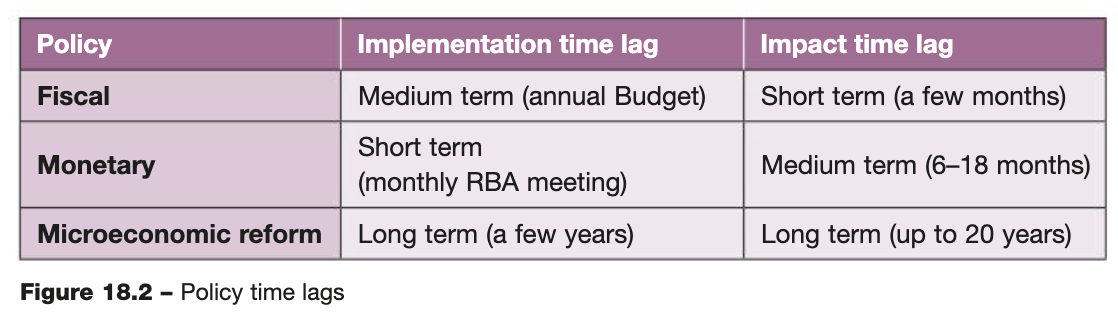
- Monetary impact takes time to affect borrowing and spending behaviours
- therefore RBA has to carefully anticipate inflation (‘==pre-emptive monetary policy==’)
- (2022) RBA delayed raising interest rates (thought inflation was just temporary from covid supply chains)
- they were wrong → fastest rise in IR since the 2-3% target’s adoption
- (2022) RBA delayed raising interest rates (thought inflation was just temporary from covid supply chains)
- therefore RBA has to carefully anticipate inflation (‘==pre-emptive monetary policy==’)
- Microeconomic has LONG implementation lag as policies are heavily researched and reviewed before enactment
- and long ass impact lag
- Monetary impact takes time to affect borrowing and spending behaviours
Global influences
- Globalisation and the international business cycle has increased the risks of financial contagion.
- (Financial crises can spread quickly due to interconnected markets)
- Govs place a high priority on maintaining international investor confidence
- World economic policy :
- (e.g. set by WTO, APEC) may set boundaries for domestic policies like protection
- e.g. the WTO forced Aus to abandon its ban on fresh salmon imports from Canada
- ‘in order to benefit the world economy’
- e.g. the WTO forced Aus to abandon its ban on fresh salmon imports from Canada
- (e.g. set by WTO, APEC) may set boundaries for domestic policies like protection
- Interest rate differential:
- If other countries raise interest rates and Australia doesn’t, foreign investment might be less attractive.
Political constraints
-
In Aus, a party must win public support for its policy platform ==in an election every 3 years==
- to continue microeconomic reform, a Gov must be re-elected
-
A bill must be passed by both houses of parliament to become law
- A gov may not have a majority in both houses, leading to implementation delays in negotiations
-
Governments may implement ‘vote-buying’ policies near election times to encourage re-election.
- (e.g., tax cuts)