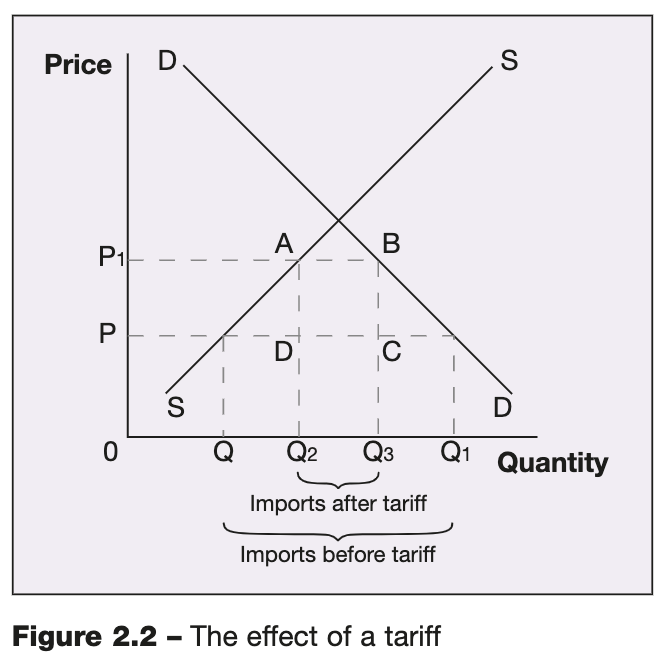
Tariffs are :: government-imposed taxes on imported goods imposed for the purpose of protecting Australian industries.
It has the effect of raising the price of the imported goods, making the domestic producer more competitive.
The effects are shown
The curves SS and DD represent domestic supply and demand.
Imports are taxed
→ prices increased (usually between current import & domestic price)
→ quantity of imported goods sold decreases
→ quantity of domestic goods increases again
the amount of gov revenue = q imported * size of the tariff
Economic effects of a Tariff
lower quality of living (consumers pay more for less)
raises revenue for the government
can provoke a retaliation effect
where a trading partner imposes some kind of trade barrier against a country imposing a tariff on its exports.
Quotas
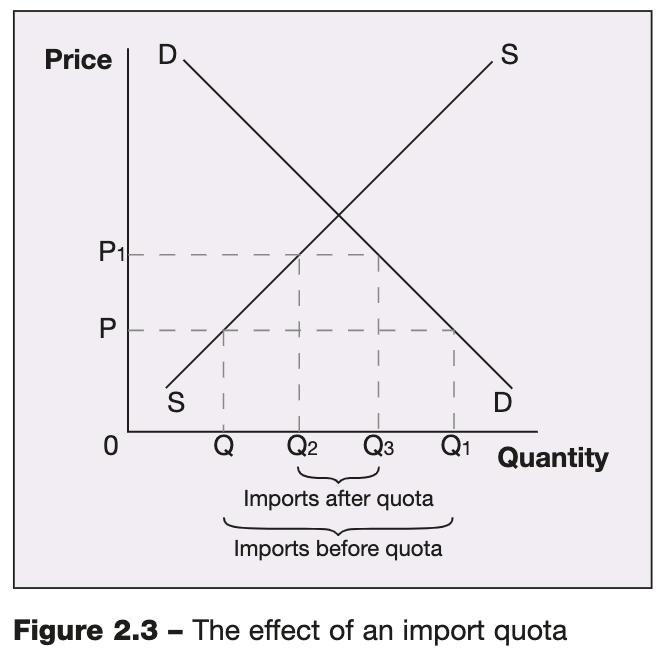
Quotas refer to :: restrictions on the amounts or values of various kinds of goods that may be imported.
The effects are shown
.
Import quantities are reduced (quota reduced)
→ quantity of imports sold are reduced
→ quantity of domestic goods increases
domestic businesses happy, consumers sad :(
units imported over a quota are usually taxed (not a hard limit)
Economic effects of a Quota
stimulates domestic production and employment
Consumers pay a higher price and receive fewer goods
unlike tariffs, quotas do not directly generate revenue for the government.
Quotas on imports can invite retaliation from the country whose exports may be reduced because of the quota.
Subsidies
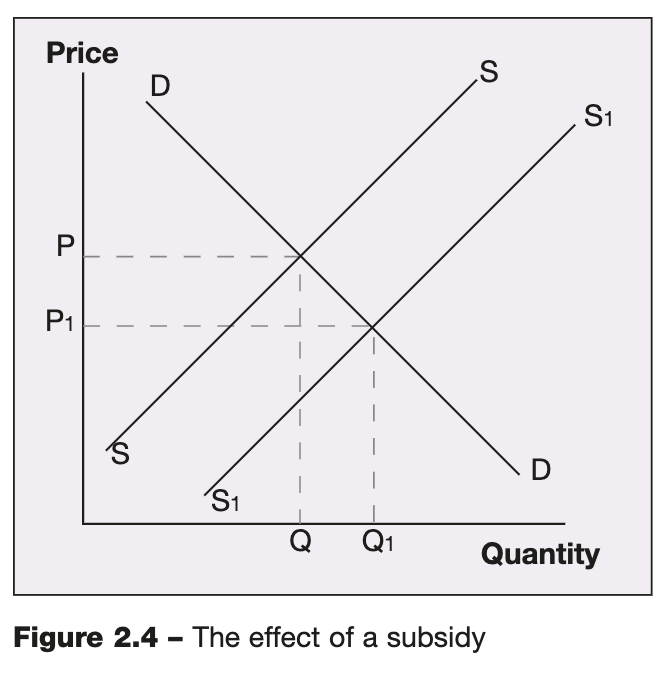
Subsidies are :: cash payments from the government to businesses to encourage production of a good or service and influence the allocation of resources in an economy.
Subsidies involve financial assistance to domestic producers,
which enables them to reduce their selling price and compete more easily with overseas producers.
Economic effects of a Subsidy
stimulates domestic production and employment
More resources in that economy are attracted to the protected industry, leading to reallocation of resources from other sectors of the economy
Consumers pay a lower price and receive more goods
Subsidies impose direct costs on government budgets
economists often prefer a subsidy to a tariff
because subsidies tend to be abolished more quickly
since they impose costs on the budget rather than generating revenue.
Local content rules
Local content rules specify :: that goods must contain a minimum percentage of locally made parts.
In return for guaranteeing that a certain percentage of a good will be locally made, the imported components may not attract a tariff.
Export incentives
Export incentive programs give :: domestic producers assistance such as grants, loans or technical advice
encourages businesses to penetrate global markets or expand their market share
Australia has the Export Market Development Grant (EMDG)
that has assisted over 51,000 businesses in promoting and marketing their exports.
Overall economic effects of protectionism
Protectionist policies reduce the overall level of trade between nations
protectionist policies reduce living standards and reduce global economic growth by shielding inefficient producers.
Protectionist policies make it more difficult for individual economies to specialise in production in which they are most efficient.